Saturday, January 29, 2011

Define Chemical Energy


One way to define chemical energy is as a form of potential energy. In the strictest definition, chemical energy is the energy involved in the bond formed between two atoms. Each bond within a chemical compounds involves different amounts of energy.
When one of these bonds breaks,  a chemical reaction occurs and chemical energy is used. The bond is released and is either reused in forming new bonds with other atoms or enters the surrounding atmosphere as heat. You can’t see chemical energy or touch it, but you can see it released when reactions occur.
The most dramatic example of chemical energy is when a stick of dynamite explodes. The TNT molecule is converted to water, carbon dioxide and carbon monoxide. Many bonds are broken and the energy supplied by the bonds breaking provides the energy to form the new bonds. The excess energy creates the visible explosion.

Types of Chemical Reactions

Some chemical reactions give off heat and some require heat to occur.

Exithermic Reactions

Reactions that give off quantities of heat are called exothermic reactions. Our example of the explosion of dynamite is an exothermic reaction.

Endothermic Reactions

Reactions that require heat to occur are called endothermic reactions. An example of an endothermic reaction is a chemical ice pack. When the pack is broken and the chemicals inside mix, the reaction draws heat from the environment, thus you feel cold.
Boiler maintenance - Tired of expensive cleaning costs? Download case study to learn more. 
Next Generation Energy... - Now! New Technology w/microwaves Energy from Waste and Biomasswww.plasma2energy.com
Chemical Microscopy - 120 Reagents. Follows approach of Chamot and Mason 

Catalysts Help Recover Energy from Chemicals

Some chemical reactions require small amounts of energy to start. While the reaction may be exothermic and produce large amounts of heat, a kick-start may be required to get the reaction going.
Think about a campfire. The wood burned in a campfire is filled with chemical energy but in order to release, it you must light the fire. By lighting the match and starting the fire, the reaction of the wood with the fire releases more heat than you supplied to begin the reaction. The amount of energy required to start a reaction varies depending on the reaction in question. A campfire is started by the introduction of a defined amount of energy to begin the reaction.
Another reaction to consider is the combustion of nitroglycerin. The amount of energy required to start that reaction is minimal. That is why nitroglycerin is so dangerous and unstable.
Chemical energy is abundant in every task and source of energy used in society. From the functioning of our bodies to the gas or electricity to run our cars, chemical energy is being used.

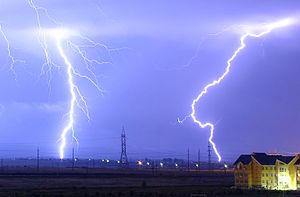
Energy


In physics, energy (from Greek ἐνέργεια - energeia, "activity, operation", fromἐνεργός - energos, "active, working") is a quantity that is often understood as the ability a physical system has to produce changes on another physical system.
The changes are produced when the energy is transferred from a system to another. A system can transfer energy by means of three ways, namely: physical orthermodynamical work, heat transfer, or mass transfer.
This quantity can be assigned to any physical system. The assigned energy, according to Classical Physics, depends on its physical state relative to the frame of reference used to study it.
On the other hand, in Relativistic Physics, when using an inertial reference frame,invariant mass energy is independent of such kind of reference frames. The invariant mass of a system is the same in all the inertial reference frames, it means that its energetic equivalent (invariant mass energy) would be the same in all the inertial reference frames, too.
All the forms of energy that a system has can belong to one of two great components: the internal energy and the external energy (not to be confused with the energy of the surroundings which is outside the system). All kinds of internal and external energies can, additionally, be classified as kinetic energy or potential energy. Kinetic energy considers the mass and the motion of a system. If the system is studied as a whole, it is called external kinetic energy. The thermal energy is the internal kinetic energy and it considers the motion of every constitutive particle of the system (molecules, atoms, electrons, etc.). The gravitational potential energy is an external potential energy and so is theelectrostatic potential energy. The elastic energy is an internal potential energy. The forms of energy are often named after a related force, as in the previous examples.
Some forms of energy are associated to the particle-like behaviour of the system. But, there might be cases like that of sound energy in which the energy overall effect is related to the wave-like behaviour of the system. In the specific case of sound, there is a transmission ofoscillations in the pressure through the system. The energy associated to the sound wave converts back and forth between the elastic potential energy of the extra compression (in case of longitudinal waves) or lateral displacement strain (in case of transverse waves) of the matter and the kinetic energy of the oscillations of the medium of which the system is made up.

Chemical Energy


Many people do not realize that of all the various kinds of energy and power that humanity has created over the past several centuries, chemical energy is the form of energy that is used most often. Chemical energy is in fact a staple in our lives, and we use it every day no matter what form of energy we are using. Batteries that are powering our cell phones and television remotes use chemical energy to perform the functions we require. At a more fundamental level, the number of chemical reactions that takes place in the burning of fossil fuels also use chemical energy. When coal is burned to provide power all over the globe, or when gasoline is combusted in our automobiles, or even when natural gas is used to provide heating power in our homes, chemical energy is used.
Chemical energy is produced through reactions that occur in chemical compounds. A chemical compound is a simple collection of many atoms that are bound to each other. As the bonds between these atoms loosens or breaks, a chemical reaction will occur, and new compounds are created. When the bonds break or loosen, oxidation occurs almost instantly.
If the chemical reaction is one that is known to be “exothermic” energy in heat form will be released, and there is a reduction in the chemical compound. When this energy is released, we can harvest this energy as power to use in our every day lives. We observe chemical energy in action every day. When the sun beats on the ground to warm it, chemical reactions are occurring that produce chemical energy in the form of heat.
Where we obtain the chemical energy is in the bond that occurs between the various atoms of a specific molecule. When a molecule breaks down and converts into newer molecules, the energy between these bonds will be released. A simple example of this is when we eat food every day. The molecules in our food are broken down into smaller pieces, and the bonds between the atoms between the molecules are also broken down. The energy that we get from food is obtained through these broken bonds and is absorbed into our bodies to use in our every day life.
Chemical energy is possibly the easiest source of energy to obtain, and it is certainly the most efficient form of energy to use and to store. It is also readily available, as we can find it in just about everything we use every day. Chemical energy is known to be a source of life and source of power for many species for several billion years. Today, technology has advanced so that we can use chemical energy towards renewable energy sources that will affect our global future.

Thursday, January 27, 2011

important picture

CHEMICAL TEST


Chemical Engineering
Chemical engineering involves the development of products with new chemicals and materials. In college, chemical engineering students study thermodynamics, fluid flow, heat transfer, chemistry, and design. Many chemical engineers work for chemical, pharmaceutical, and oil companies. However, chemical engineers also work in the food industry and design the manufacture of household products, plastics and automotive parts. In the food industry, a chemical engineer might work on making a processed cheese slice that has more calcium in it. They might also work to make fuel that is less harmful to the environment or develop new ways to recycle used products.

CHEMICAL ENGINEERING CAREERS


 Chemical Engineering:
Over the last few years, the chemical engineering profession has grown by leaps and bounds. When you think of the world around you everything is made of chemicals. This opens up a vast plethora of career opportunities for people in this realm and who want to make a career in chemical engineering. The never ending need for chemical engineers is growing by the day because of the several different applications in the industries that use chemicals in different permutations and combinations.
Chemical-Engineering-Careers
Degrees:
The degrees that a person needs to become a Chemical engineer is the option of Physics, mathematics and Chemistry at the XII grade and then a four year degree in the field of engineering specializing in Chemical Engineering. Therefore the degrees that one should have are B.E/B.Tech or a postgraduate degree that is an M.E in Chemical Engineering.
Chemical Engineering Job Prospects:
The job prospects for chemical engineers are really bright as they are required to work with different chemicals to manufacture better products. Chemical engineers are required in the field of plastics, paints, fuels, medicines, paper, and several others. The job of a chemical engineer is to decipher various permutations and combinations of the chemicals and what will get the right kind of reaction out of the chemicals to suit specific requirements.
Kind of job positions:
Due to the field of chemical engineering being so very vast the job prospects for Chemical engineers are also equally spread out in several industries such as petrochemicals, plastics, power production, food materials and environmental control.
Chemical Engineers could go on to gain expertise in one particular branch of Chemical engineering be it plastics. There are several job opportunities in the public as well as private sector.
The main fields in which the jobs exist are processing, manufacturing, research, construction and design. After completing their B.Tech or B.E degrees a Chemical engineer can further their career goals by getting an MBA. These two degrees, an engineering and management degree, is the most coveted for private company employment.
The positions that a person could get in this field is that of a supervisor, manager, project manager or a technical specialist. There are several top-notch companies that employ chemical engineers by the dozen. In the government sector they have more about water plant and waste management.
Chemical Engineers Salaries:
The salaries are in tandem with the plethora of opportunities available to one. There are several sectors that have openings for Chemical Engineers be they the Central or the State Government or the private and corporate companies. The salary that a chemical engineer will get for a government job is from 10,000 to 12,000. A chemical engineer with a diploma will earn 5000 to 9000 at the beginning of their career. If a chemical engineer decides to teach at the degree level then the starting salary ranges from 12000 to 13000. As they gain further experience in their field and branch out as consultants they could earn as high as 50,000 per assignment.

CHEMICAL

Chemical engineering is the branch of engineering that deals with the application of physical science (e.g. chemistry and physics), with mathematics, to the process of converting raw materials or chemicals into more useful or valuable forms. In addition to producing useful materials, chemical engineering is also concerned with pioneering valuable new materials and techniques, an important form of research and development. A person employed in this field is called a chemical engineer.

Tuesday, January 25, 2011

CHEMICAL ENGINEERING COOP


Students can work for a company as a chemical engineering coop student (for credit) or as a chemical engineering intern (not for credit). Students who intern – without enrolling for any credit – do not need to meet any departmental requirements or st
andards.
The chemical engineering department strongly encourages students to participate in an internship or coop experience. Students desiring credit for coop experience may enroll in ChE 3951. This course is open to sophomores, juniors, or seniors who have been admitted to the chemical engineering program and who are in good standing in the department. Transfer students must complete ChE 2111 before enrolling in ChE 3951. Both internships and coops can be done for any period of time; generally for 3 to 15 months. However, long-term internship (more than a summer) causes problems with student status and related issues if the student is not enrolling in a course for credit. Download a course syllabus (pdf)
Completion of the COOP Contract is required for registration in ChE 3951.
Students can enroll (and pay tuition):
  • For 1 to 3 credit of coop per semester (summer is a semester for that purpose).
  • For longer coops, it is better to register for all three coop credits during the summer. This would prevent the loans from entering repayment during the semester when you are on coop, as well as reduce costs for fees.
Those credits can be used to:
  • Transfer students may satisfy the 3-credit requirement of Intro to ChE (ChE 1011).
  • The 3-credit requirement of Science or Engineering elective.
Students who do not need these credits may still wish to enroll for coop because:
  • It allows them to remain “full time" student in the eyes of all medical insurance companies (the dept. head writes a letter to the insurance company if needed – no insurance company has ever denied coverage for coop students after receiving our letter).
  • International students (visa) must work with the International Student Counselor regarding remaining full-time student status.
  • Documents your engineering work experience for potential employers and looks better on the resume.
  • Provides experience in multidisciplinary engineering environments.
Coop students get letter grades. The following requirements must be fulfilled:
  • Write a formal report and submit it to the department head at the end of the semester. The report format (and these requirements) is detailed below. Generally one report is needed for all consecutive coops. However, greater details (length) are expected for greater credit (about five pages/credit). The grade is entirely dependent on this report.
  • The students must arrange to make a presentation to the Chemical Engineering Department's Industrial Advisory Committee or AIChE student chapter after returning to campus. The presentation is not graded.
  • The student must fill out a survey form and ask his/her employer to fill out a similar form. Neither of the surveys is used in grading the student.
Course Description: Coop involves engineering related work experience in industry or government. These positions are typically paid and generally involve 40 hours/week for one to three semesters. The student will most likely need to temporarily relocate to the employer’s location. The student is responsible for obtaining the coop position; however, the department and the career services assist students in this regard. Talk toCareer Services about your interest in participating in the program. E-Fest, the UMD engineering job fair in October, is a time when many companies interview on campus for their regular as well as internship and coop positions. The department also alerts all ChE majors when information about new coop positions becomes available.
Reporting Requirement: Each time a student enrolls for coop credit (1) a coop report detailing the work experience must be prepared, (2) self-evaluation survey (3) request his/her employer to send a one-page evaluation survey of the coop work, and (4) make presentations to the Chemical Engineering Department's Industrial Advisory Committee and the AIChE student chapter meeting. For a student going for a consecutive second "term" (semester following a summer or summer following a semester) only one set of "final" report, evaluation and presentations is required. The final report must be submitted before grade reporting time for the semester.
Evaluations: Students and employer/supervisors must complete an anonymous survey of the student's coop experience. Evaluations may be returned to the UMD Chemical Engineering Department by email, fax, or post. The student should provide a copy of the survey and a self-addressed, stamped envelope to their employer/supervisors.

Report Format: Typical report length is 5 to 15 pages (for 1 to 3 credits), not including appendices. Thisreport and evaluation surveys are submitted to the Department Head before grade reporting time for the semester or summer term. The report should summarize the student’s work experience and discuss in detail a variety of educational aspect of the experience. The report should strive to demonstrate how their educational experience has prepared them for coop and how coop has affected their education. In particular, the report should discuss and assess multidisciplinary experiences gained from the coop. Inappropriate report items include confidential material, overly technical discussion of the work, heavy reliance on internal jargon, chronological listings of tasks ("Dear Diary ..."), or other topics that do not demonstrate a synthesis of the coop experience and the student’s education.
The report should be written for someone technically literate, but who may not be familiar with what was done. The report might consist of the following parts:
  • Cover page with your identifying information.
  • Number all pages
  • Use headings on a separate line for each section.
  • Executive Summary/Abstract – Describe briefly the main tasks you performed. This should be a very short (less than a page), succinct, to the point description of what you accomplished. Length: maximum 1 page.
  • Introduction –Describe the place where the work was done including what materials or services it provides. Next give the problem statement(s) and background information you were given from your supervisor or co-workers. This is also a good place to describe the disciplines of people you worked with (engineers, business, sales, etc). You may have done multiple projects or only one, so the length will vary accordingly. Length: 1 to 3 pages. 
  • Background – Discuss what ideas you needed to use in order to accomplish your objectives and how did they relate to your education. This would be a good place to discuss any new material you needed to learn. Length: 1 to 3 pages. 
  • Procedures – Describe any new procedures you may have learned and how they were needed to accomplish your objectives. Do not provide details of operation, just a summary of the new equipment used and its purpose (i.e. I learned to use a dissolved oxygen meter to test for the presence of oxygen in boiler water which can cause corrosion in boiler tubes). Length: 1 to 4 pages. 
  • Results – Describe what was accomplished based on the work you did. Write about any new information or procedures you helped develop. Length: 1 to 4 pages. Include information about working in a multidisciplinary environment. 
  • Discussion – Provide your interpretation of the results of your project(s). It is acceptable to discuss them even if nothing was changed, or your project failed to find a better solution. You should also discuss the value this opportunity provided to your education in terms of engineering skills and working in multidisciplinary environments.

Career Opportunities


Clearly, a degree in Chemical Engineering has always provided the skills to open doors to the careers of the future - and combined degrees will only increase these opportunities. There has been a steady growth in the worldwide demand for graduate Chemical Engineers, and since the move to combined courses has been in response to an industrial need, there is no reason to doubt that these graduates will also be in demand.

It is the multi-disciplinary skills that a Chemical Engineering degree affords that enables graduates to keep their options open. They are a valuable resource to many employers and are thus well rewarded. The latest salary survey undertaken by the IChemE shows that Chemical Engineers consistently earn more on average than those in other engineering disciplines.

So, if it all sounds like the future for you,  and take the first step on your journey to a fun-packed, well rewarded and fulfilling career. Chemical Engineering - could it be for you?

What is Chemical Engineering


Chemical Engineers are employed around the world in a first-class, largely graduate profession. They work in a variety of sectors, ranging from chemicals to energy, food and drink, pharmaceuticals and health care. The roles they undertake are numerous and include inventing, designing, constructing, operating and controlling industrial processes for a wide range of products on which everyone's standard of living depends.

These products may be bulk commodity chemicals and polymers, such as plastics, or more specialised products manufactured on a small scale, such as enzymes. Products are made by inducing chemical or physical changes in materials, through reaction or separation and mixing, for example - a Chemical Engineer must understand these processes at the molecular level as well as on a factory scale.

Many of the companies employing Chemical Engineers are names that are instantly recognised all over the world, such as Cadbury Schweppes, GlaxoSmithKline, Procter and Gamble, Esso and Unilever, to name but a few. There are opportunities to work in small and medium sized businesses that frequently provide technical services to the larger concerns. For the adventurous, there are also opportunities to operate either as a consultant within a particular industry sector, or to run your own business.


Practical Solutions


At the forefront of tomorrow's scientific and technological development, tackling some of the world's most urgent problems, Chemical Engineers are also rising to the challenge of finding innovative and practical solutions which are economically viable, environmentally benign and safe.

If you are bright, a good communicator, motivated, able to work on your own or as part of a team, and are interested in a challenge, you are a prime candidate to study Chemical Engineering at university. A good level of education with a strong scientific element, preferably including Maths and Chemistry, is required, although other science subjects are acceptable.

For a number of years, students have had the opportunity to combine the study of Chemical Engineering with other areas, such as languages or management, giving a broader feel to the degree. There have also been opportunities for increased specialisation while still studying at undergraduate level by taking courses that focus on specific areas, such as the environment. Further examples of combined courses have featured Applied Chemistry, thus adding a further dimension in terms of both depth and breadth. Graduates from these courses continue to be valued in areas that are considered 'traditional' Chemical Engineering.
Chemical Engineering 
We live in a fast-moving world, and 'new technologies' are beginning to feature as major employers of graduates in science-based and technological areas. This has resulted in a need for an increased number of graduates with a greater understanding of science, combined with the skills offered as a result of studying Chemical Engineering. The Institution has therefore collaborated with the Royal Society of Chemistry to develop a scheme that recognises a combined course in Chemical Engineering and Chemistry. To date, one such course has been accredited by the Institution of Chemical Engineers (IChemE), with the potential for others to follow suit.

Completion of an accredited degree and four or five years industrial experience (possibly through a formal training program) can lead to full membership of the IChemE (meaning you can use the letters MIChemE after your name) and be accorded status as a Chartered Chemical Engineer - essential in any successful career in Chemical Engineering.

Universities welcome international students, and most have lively international communities with good support systems that often extend to your family during the period you are at university.

Universities recognise most foreign qualifications, but if you are unsure about whether your qualifications are suitable for your chosen degree programme, universities are happy to advise. They can also offer advice on all other matters relating to living and studying in the UK. In these circumstances, the International Office or the Admissions Tutor in the Department should be the first port of call.