Saturday, January 29, 2011

Define Chemical Energy


One way to define chemical energy is as a form of potential energy. In the strictest definition, chemical energy is the energy involved in the bond formed between two atoms. Each bond within a chemical compounds involves different amounts of energy.
When one of these bonds breaks,  a chemical reaction occurs and chemical energy is used. The bond is released and is either reused in forming new bonds with other atoms or enters the surrounding atmosphere as heat. You can’t see chemical energy or touch it, but you can see it released when reactions occur.
The most dramatic example of chemical energy is when a stick of dynamite explodes. The TNT molecule is converted to water, carbon dioxide and carbon monoxide. Many bonds are broken and the energy supplied by the bonds breaking provides the energy to form the new bonds. The excess energy creates the visible explosion.

Types of Chemical Reactions

Some chemical reactions give off heat and some require heat to occur.

Exithermic Reactions

Reactions that give off quantities of heat are called exothermic reactions. Our example of the explosion of dynamite is an exothermic reaction.

Endothermic Reactions

Reactions that require heat to occur are called endothermic reactions. An example of an endothermic reaction is a chemical ice pack. When the pack is broken and the chemicals inside mix, the reaction draws heat from the environment, thus you feel cold.
Boiler maintenance - Tired of expensive cleaning costs? Download case study to learn more. 
Next Generation Energy... - Now! New Technology w/microwaves Energy from Waste and Biomasswww.plasma2energy.com
Chemical Microscopy - 120 Reagents. Follows approach of Chamot and Mason 

Catalysts Help Recover Energy from Chemicals

Some chemical reactions require small amounts of energy to start. While the reaction may be exothermic and produce large amounts of heat, a kick-start may be required to get the reaction going.
Think about a campfire. The wood burned in a campfire is filled with chemical energy but in order to release, it you must light the fire. By lighting the match and starting the fire, the reaction of the wood with the fire releases more heat than you supplied to begin the reaction. The amount of energy required to start a reaction varies depending on the reaction in question. A campfire is started by the introduction of a defined amount of energy to begin the reaction.
Another reaction to consider is the combustion of nitroglycerin. The amount of energy required to start that reaction is minimal. That is why nitroglycerin is so dangerous and unstable.
Chemical energy is abundant in every task and source of energy used in society. From the functioning of our bodies to the gas or electricity to run our cars, chemical energy is being used.

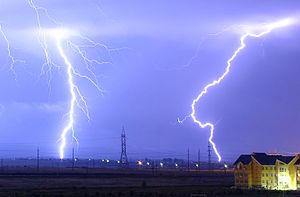
Energy


In physics, energy (from Greek ἐνέργεια - energeia, "activity, operation", fromἐνεργός - energos, "active, working") is a quantity that is often understood as the ability a physical system has to produce changes on another physical system.
The changes are produced when the energy is transferred from a system to another. A system can transfer energy by means of three ways, namely: physical orthermodynamical work, heat transfer, or mass transfer.
This quantity can be assigned to any physical system. The assigned energy, according to Classical Physics, depends on its physical state relative to the frame of reference used to study it.
On the other hand, in Relativistic Physics, when using an inertial reference frame,invariant mass energy is independent of such kind of reference frames. The invariant mass of a system is the same in all the inertial reference frames, it means that its energetic equivalent (invariant mass energy) would be the same in all the inertial reference frames, too.
All the forms of energy that a system has can belong to one of two great components: the internal energy and the external energy (not to be confused with the energy of the surroundings which is outside the system). All kinds of internal and external energies can, additionally, be classified as kinetic energy or potential energy. Kinetic energy considers the mass and the motion of a system. If the system is studied as a whole, it is called external kinetic energy. The thermal energy is the internal kinetic energy and it considers the motion of every constitutive particle of the system (molecules, atoms, electrons, etc.). The gravitational potential energy is an external potential energy and so is theelectrostatic potential energy. The elastic energy is an internal potential energy. The forms of energy are often named after a related force, as in the previous examples.
Some forms of energy are associated to the particle-like behaviour of the system. But, there might be cases like that of sound energy in which the energy overall effect is related to the wave-like behaviour of the system. In the specific case of sound, there is a transmission ofoscillations in the pressure through the system. The energy associated to the sound wave converts back and forth between the elastic potential energy of the extra compression (in case of longitudinal waves) or lateral displacement strain (in case of transverse waves) of the matter and the kinetic energy of the oscillations of the medium of which the system is made up.

Chemical Energy


Many people do not realize that of all the various kinds of energy and power that humanity has created over the past several centuries, chemical energy is the form of energy that is used most often. Chemical energy is in fact a staple in our lives, and we use it every day no matter what form of energy we are using. Batteries that are powering our cell phones and television remotes use chemical energy to perform the functions we require. At a more fundamental level, the number of chemical reactions that takes place in the burning of fossil fuels also use chemical energy. When coal is burned to provide power all over the globe, or when gasoline is combusted in our automobiles, or even when natural gas is used to provide heating power in our homes, chemical energy is used.
Chemical energy is produced through reactions that occur in chemical compounds. A chemical compound is a simple collection of many atoms that are bound to each other. As the bonds between these atoms loosens or breaks, a chemical reaction will occur, and new compounds are created. When the bonds break or loosen, oxidation occurs almost instantly.
If the chemical reaction is one that is known to be “exothermic” energy in heat form will be released, and there is a reduction in the chemical compound. When this energy is released, we can harvest this energy as power to use in our every day lives. We observe chemical energy in action every day. When the sun beats on the ground to warm it, chemical reactions are occurring that produce chemical energy in the form of heat.
Where we obtain the chemical energy is in the bond that occurs between the various atoms of a specific molecule. When a molecule breaks down and converts into newer molecules, the energy between these bonds will be released. A simple example of this is when we eat food every day. The molecules in our food are broken down into smaller pieces, and the bonds between the atoms between the molecules are also broken down. The energy that we get from food is obtained through these broken bonds and is absorbed into our bodies to use in our every day life.
Chemical energy is possibly the easiest source of energy to obtain, and it is certainly the most efficient form of energy to use and to store. It is also readily available, as we can find it in just about everything we use every day. Chemical energy is known to be a source of life and source of power for many species for several billion years. Today, technology has advanced so that we can use chemical energy towards renewable energy sources that will affect our global future.